


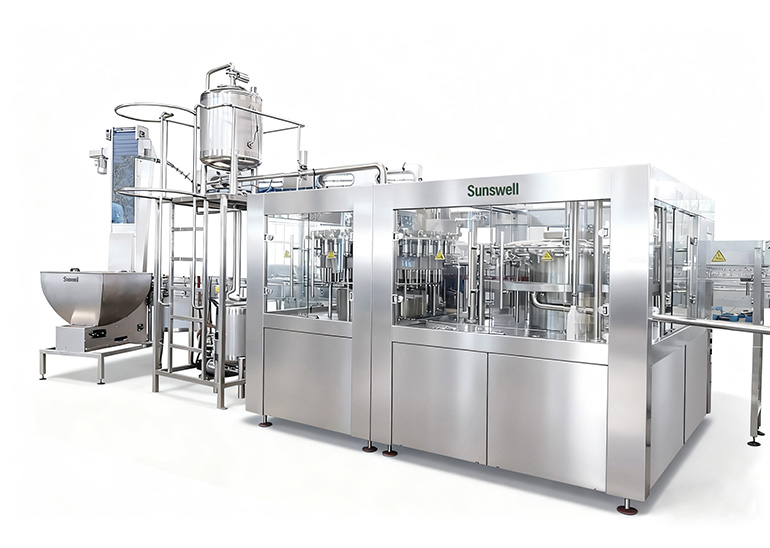
Production line · Dairy
Dairy & Milk Drinks Production Line
Milk is a low-acid product with a short shelf life unless it is properly processed, which makes the preservation route the whole project: UHT processing for shelf-stable, or pasteurising plus a cold chain for fresh. This page walks the line and the decisions that set it.
444+
Lines delivered
71+
Countries exported
20,000
m² workshop
80+
Staff
2011
Sunswell founded
Short answer: A milk drinks line runs: reception and storage → standardising and homogenising → heat treatment (UHT for shelf-stable, pasteurising for fresh) → hygienic filling into bottles or cartons → capping → packing — with chilling where the product must stay cold. The preservation route is decided first, because it sets the heat treatment, the filling hygiene and the whole supply chain.
🎯 Key takeaways
- Milk is low-acid and perishable — the preservation route is decided before the line, not on it.
- UHT plus hygienic filling gives shelf-stable product; pasteurising plus a cold chain gives fresh.
- Homogenising stabilises the fat and the body of the drink.
- Hygienic filling and a sealed product path are the difference between shelf life and spoilage.
- The cold chain, where required, is part of the line's operating plan, not a footnote.
On this page
1. The preservation decision
Milk drinks split into two worlds: shelf-stable products, preserved by UHT processing followed by hygienic filling into a sealed package; and fresh products, preserved by pasteurising and carried by a cold chain to the shelf. The route decides the heat treatment, the filling hygiene, the package and the logistics — so it is the first decision, made with the market and the shelf-life target, not the last.
For the preservation and filling route that fits a specific product, contact Sunswell with the product and shelf-life target — the line follows the route.
2. The complete process
The line: milk reception and storage → standardising (fat and solids to target) → homogenising → heat treatment (UHT or pasteurising) → hygienic filling → capping → packing → cold storage or ambient, per the route. Every station protects the next, and the product path is kept sealed and hygienic from heat treatment to package.
The dairy plant is a process plant with a filling line at its end — the process side is where the shelf life is won.
3. Standardising and homogenising
Standardising sets the fat and solids content to the recipe; homogenising breaks the fat globules so the milk stays uniform and the body is stable. Both are dairy-specific steps that juice and water lines do not have, and both are engineered around the product's fat and protein behaviour.
Flavoured milk drinks add batching and flavouring before heat treatment — the batching path is specified with the recipe.
4. Heat treatment
UHT processing gives shelf-stable milk: the product is heated briefly to a high temperature, then cooled and filled hygienically into a sealed package — no refrigeration needed until opening. Pasteurising gives fresh milk: a gentler heat, a shorter shelf life and an unbroken cold chain. The choice is the product's identity — and it is an engineering spec, not a marketing claim.
The heat treatment is validated per product (time, temperature, flow) and the records are part of the plant's food-safety file.
5. Hygienic filling
After UHT processing, the product is filled into a sealed package through a hygienic filling path: the filler, the pipework and the packaging interface are kept sealed and clean, with the CIP and steam-sterilisation cycles as part of the machine's routine. The hygiene level of the filler is the difference between a shelf-stable product and a spoilage event.
The filling room layout, air handling and operator hygiene are designed with the filler — ask the supplier for the hygiene specification with the proposal.
6. Bottles and cartons
Milk drinks package into bottles (PET or glass) and cartons. Bottles run a conventional filler with a capper — the hygienic requirement is the difference; cartons run a form-fill-seal line that is a separate machine family. The package decision sets the filling section, and both routes need the same upstream process.
Bottle weight and closure follow the product and the route — a shelf-stable drink in PET and a fresh drink in the same bottle are different specs at the filler.
7. The cold chain
Fresh products depend on the cold chain from filler to shelf: chilled storage, refrigerated transport and retail chillers. The line's output must flow into a cold chain that is sized, contracted and verified — a pasteurised product held at the wrong temperature is a recall, whatever the line did right. Shelf-stable products skip this, which is their logistics advantage.
Plan the cold chain before the line: capacity, distance, chiller space and the temperature records that prove it.
Frequently asked questions
Is milk filled like juice or water?
No — milk is low-acid and needs hygienic filling after UHT or pasteurising. The filling hygiene and the sealed path are the shelf-life controls.
UHT or pasteurised?
UHT plus hygienic filling is shelf-stable; pasteurising plus a cold chain is fresh. The route is set by the market and the shelf-life target.
Why homogenise milk?
To break the fat globules so the drink is uniform and stable — a dairy-specific step that water and juice lines do not have.
Do I need a cold chain?
Only for fresh (pasteurised) products — and it must be planned, sized and verified before the line runs.
Can a small dairy start with bottles?
Yes — a hygienic filling line for PET or glass at small output is a standard configuration; the process side (UHT or pasteuriser) is the real investment.
Does Sunswell supply dairy lines?
Yes — Sunswell supplies hygienic filling lines for milk drinks with the process side engineered to the preservation route. Contact Sunswell with the product and shelf-life target for the correct route.
About the author
Written by the Sunswell engineering team — led by Howie SUN, Founder & CEO, with 14 years in filling and blow-moulding equipment R&D and turnkey project delivery across 71+ countries.
Last reviewed: 2026-08-28 · Reviewed by Sunswell engineering team
Ask our engineering team →Recommend Products
Have a specific project in mind?
Tell us product, target BPH, bottle sizes and market. We reply with a draft layout, equipment list and lead time estimate.
Fill the inquiry form ↑