


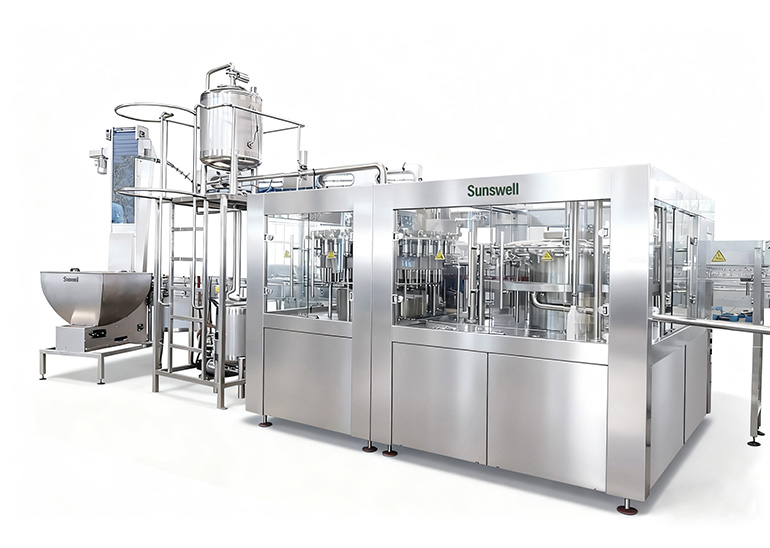
Line configuration · Dairy
Dairy & Milk Drinks — Line Configuration Options and Investment Levels
Milk drinks configure around the preservation route first — UHT plus hygienic filling for shelf-stable, or pasteurising plus a cold chain for fresh — and the route decides the heat treatment, the filling hygiene and the package. This page compares the configurations and their trade-offs.
444+
Lines delivered
71+
Countries exported
20,000
m² workshop
80+
Staff
2011
Sunswell founded
Short answer: Two routes define dairy configurations: shelf-stable (UHT processing then hygienic filling into a sealed package — no cold chain) and fresh (pasteurising, shorter shelf life, an unbroken cold chain). Within each route, the levels follow output and packaging — bottles (PET or glass) run a hygienic filler with a capper; cartons run a form-fill-seal line. The route is decided with the market and the shelf-life target, not on the line.
🎯 Key takeaways
- The preservation route comes first: UHT + hygienic filling, or pasteurising + cold chain.
- Shelf-stable skips the cold chain — a logistics advantage worth pricing into the decision.
- Bottles run a hygienic filler with a capper; cartons are a form-fill-seal line.
- Homogenising and standardising sit upstream and are dairy-specific.
- The hygiene level of the filler is the shelf-life control — it is a spec, not a default.
On this page
1. The route decision
Milk drinks split into two worlds at the planning stage: shelf-stable products, preserved by UHT processing followed by hygienic filling into a sealed package, and fresh products, preserved by pasteurising and carried by a cold chain. The route decides the heat treatment, the filling hygiene, the package and the logistics — so it is the first decision, made with the market and the shelf-life target.
For the preservation and filling route that fits a specific product, contact Sunswell with the product and shelf-life target — the line follows the route.
2. Shelf-stable route
The shelf-stable route: standardising and homogenising → UHT processing → hygienic filling into a sealed package → packing → ambient storage. The UHT step gives the product its long shelf life, and the filling path is kept sealed and hygienic so nothing re-enters after processing. The configuration's reward is logistics freedom — no cold chain from plant to shelf.
The investment is higher up front (UHT plant, hygienic filler), and the return is in distribution economics and exportability.
3. Fresh route
The fresh route: pasteurising, hygienic filling, packing and chilled distribution — a shorter shelf life carried by an unbroken cold chain. The line is simpler and cheaper than UHT; the cold chain is the ongoing cost and the risk. Fresh suits markets with dense, fast retail and short distances; it struggles where the chain is long or warm.
Plan the cold chain before the line: chiller space, refrigerated transport and the temperature records that prove it.
4. Bottles vs cartons
Bottles (PET or glass) run a hygienic filler with a capper — the milk-specific part is the hygiene level and the sealed product path. Cartons run a form-fill-seal line, a separate machine family that forms, fills and seals the carton in one process. The package decision sets the filling section and follows the market — bottles for home consumption, cartons for schools, catering and ambient products.
Bottle weight and closure follow the route: a shelf-stable drink in PET and a fresh drink in the same bottle are different specs at the filler.
5. Investment levels
| Level | Configuration | Best fit |
|---|---|---|
| Entry | Pasteurising + hygienic bottle filler | Local fresh market |
| Standard | UHT + hygienic filler, bottles | Regional shelf-stable brand |
| Volume | UHT + bottles + cartons line | National, multi-format |
The levels follow the market's shelf-life need and format mix — a plant serving a hot, long chain needs the UHT tier even at modest volume.
6. The process side
The process side — reception, standardising, homogenising, heat treatment — is dairy-specific and sits upstream of the filler. Homogenising stabilises the fat; standardising sets the recipe; the heat treatment is validated per product with records. The process plant is where the shelf life is won; the filler is where it is kept.
Flavoured milk drinks add batching and flavour dosing before heat treatment — the batching path is specified with the recipe.
7. Matching to market
Match the configuration to three facts: the shelf-life the market needs (hot, long chains demand UHT), the format the consumers buy (bottles, cartons or both), and the cold-chain reality (available and affordable, or not). The answer is a route, then a level — and the line follows both. The filling machine range shows the filler side; the process side is engineered with it as one system.
Frequently asked questions
UHT or pasteurised?
UHT plus hygienic filling is shelf-stable with no cold chain; pasteurising plus a cold chain is fresh. The route is set by the market and the shelf-life target.
Bottles or cartons?
Bottles run a hygienic filler with a capper; cartons are a form-fill-seal line. The choice follows the market's format and the product's ambient or chilled position.
Why is the filling hygiene so important?
After UHT processing, the filling path must stay sealed and clean or the product re-contaminates. The hygiene level is the shelf-life control.
Is the cold chain avoidable?
Yes — the shelf-stable route skips it, which is its logistics advantage. Fresh products cannot skip it.
What output suits a first dairy line?
Entry configurations cover local fresh markets; volume means UHT and multi-format. Size to the market's shelf-life need first, output second.
Can Sunswell supply dairy configurations?
Yes — Sunswell supplies hygienic filling lines for milk drinks with the process side engineered to the preservation route. Contact Sunswell with the product and shelf-life target.
About the author
Written by the Sunswell engineering team — led by Howie SUN, Founder & CEO, with 14 years in filling and blow-moulding equipment R&D and turnkey project delivery across 71+ countries.
Last reviewed: 2026-08-28 · Reviewed by Sunswell engineering team
Ask our engineering team →Recommend Products
Have a specific project in mind?
Tell us product, target BPH, bottle sizes and market. We reply with a draft layout, equipment list and lead time estimate.
Fill the inquiry form ↑