


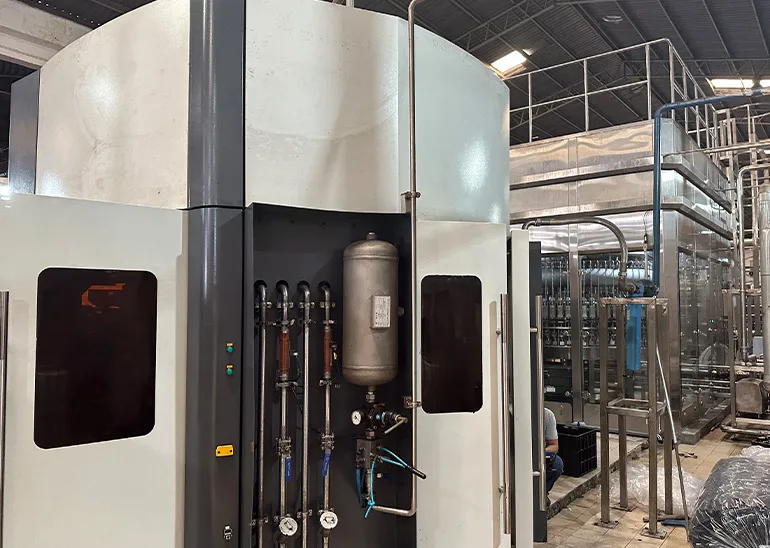
How it works · CSD
CSD & Sparkling Water Machine — How It Works and Key Components
A CSD filling machine uses isobaric counter-pressure valves so carbonation stays in solution. The bottle is pressurised with CO₂ before the liquid opens — that is what keeps it from foaming.
2,000–24,000
BPH range
Isobaric
Valve type
444+
Lines delivered
71+
Countries exported
CO₂
Handled inline
Short answer: Carbonated drink cannot be filled like still water — open a gravity valve and the CO₂ comes out as foam. An isobaric valve equalises bottle and tank pressure with CO₂ first, fills through a return pipe, then vents slowly. Speed is lower per valve than still water because of the dwell; accuracy and foam control come from the counter-pressure design, not from a faster valve.
🎯 Key takeaways
- CSD needs isobaric counter-pressure filling, not gravity.
- The bottle is pressurised with CO₂ before the liquid opens.
- Snift pipe returns displaced gas; foam and loss stay low.
- CSD valves dwell longer, so same BPH needs a bigger turret than water.
- A chiller upstream is part of the scope, not an extra.
On this page
1. The CSD process flow
Bottles are rinsed, then taken to the isobaric filler. The filler pre-pressurises each bottle with CO₂, fills against the pressure through a return (snift) pipe, and only then releases pressure. Capping happens under light counter-pressure to keep gas in. The whole fill is a pressure-balanced operation, not a pour.
Upstream, a carb mixer doses syrup, water and CO₂ to a target gas volume; downstream, the capper and any pasteuriser must keep pace without losing pressure at the seam.
2. Why isobaric filling
If you fill a carbonated bottle at atmospheric pressure, the drink degasses the instant the valve opens — foam, loss of carbonation and inconsistent fill. Isobaric filling holds the bottle at tank pressure so the liquid enters without a pressure drop, and the snift pipe returns displaced gas instead of venting it to waste.
| Step | Purpose |
|---|---|
| Pre-pressurise | Match bottle to tank pressure |
| Fill (return pipe) | Liquid in, gas back, no foam |
| Snift/vent | Slow pressure release, gas retained |
| Cap under pressure | Seal before degassing |
Isobaric is not optional for CSD. A gravity or mechanical valve cannot hold carbonation during fill — it foams and loses gas.
3. CO2 handling and carbonation
The carb mixer sets gas volume (volumes of CO₂) by product; the filler holds it. CO₂ is supplied from a bulk tank or cylinders, chilled, and metered. Chilling the product before fill reduces foaming and lets you hold more gas, so a chiller is part of the scope, not an extra.
Gas handling is a safety and consistency item: relief, monitoring and a clean CO₂ supply all belong in the design. The carbonation FAQ covers volumes and dosing in more detail.
4. Key components
The isobaric filler turret and valves set speed and foam control. The capper must seal under counter-pressure and match the closure. The carb mixer and chiller sit upstream; the snift recovery loop recycles displaced CO₂.
For a combiblock the same filler is integrated with blowing, so there is no separate blow stage — but the isobaric fill is identical physics.
5. Speed and accuracy
CSD valves dwell longer than still-water valves, so a 12,000 BPH CSD block is a larger machine than a 12,000 BPH water block. Accuracy comes from the counter-pressure design and good CO₂ control, not from weighing — though semi-electric valves add flow metering for tighter repeatability.
Size a CSD line on the carbonated case. If the same block also runs still water, the still water will run under the rated BPH.
6. Choosing your configuration
Inputs: gas volume and product, bottle drawing, target output, closure, and whether the bottle is blown in-line. Below ~8,000 BPH a separate line is often cheaper; above that the combiblock saves footprint and bottle weight. The valve choice (isobaric vs semi-electric) is in the filler-valve comparison.
7. Specifying the machine
Send the product and target gas volume, bottle drawing, closure and speed per format. The supplier returns valve count, turret size, capper spec and the CO₂ and chiller scope — the real capacity and foam-control statement, on your bottle.
Frequently asked questions
Why can't CSD use a gravity filler?
A gravity valve opens at atmospheric pressure and the CO₂ degasses as foam. Isobaric filling holds tank pressure so carbonation stays in solution.
What does the snift pipe do?
It returns displaced CO₂ from the bottle during fill instead of venting it, holding gas in the product and reducing loss.
How fast can a CSD line run?
Roughly 2,000 to 24,000 BPH; CSD valves dwell longer than water valves, so the same BPH needs a larger turret.
Is a chiller needed?
Yes. Chilling the product before fill cuts foaming and lets you hold more gas; the chiller is part of the scope, not an add-on.
Block or separate line for CSD?
Above ~8,000 BPH a combiblock usually wins on footprint and bottle weight; below that a separate blow moulder plus filler is often cheaper.
What should I send the supplier?
Product and gas volume, bottle drawing, closure, speed per format. Rated speed must come back on your actual drawing.
About the author
Written by the Sunswell engineering team — led by Howie SUN, Founder & CEO, with 14 years in filling and blow-moulding equipment R&D and turnkey project delivery across 71+ countries.
Last reviewed: 2026-08-28 · Reviewed by Sunswell engineering team
Ask our engineering team →Recommend Products
Project references
-

Vizit, 12,000BPH 1L Bottling Line with Combiblock for CSD, Kazakhstan
Country: Kazakhstan
Product: PET Bottled Carbonated Soft Drinks
Capacity: 12000BPH (1L)
Solution:Carbonated Drinks Production Line
Read More + -
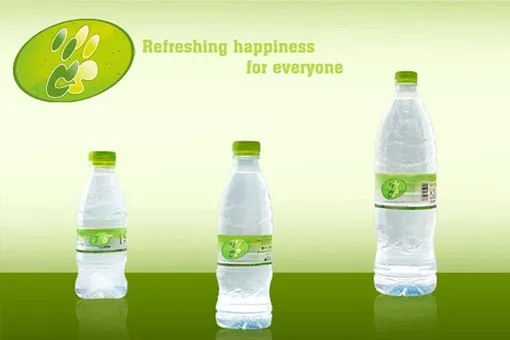
Taza, 4 Sets of 12,000BPH 1.5L Bottling Lines with Combiblock for Water, Maldives
Country: Maldives
Product: PET Bottled Mineralized Water
Capacity: 24,000BPH (500ml); 2 Lines
Solution:Water Production Line
Read More +
Have a specific project in mind?
Tell us product, target BPH, bottle sizes and market. We reply with a draft layout, equipment list and lead time estimate.
Fill the inquiry form ↑