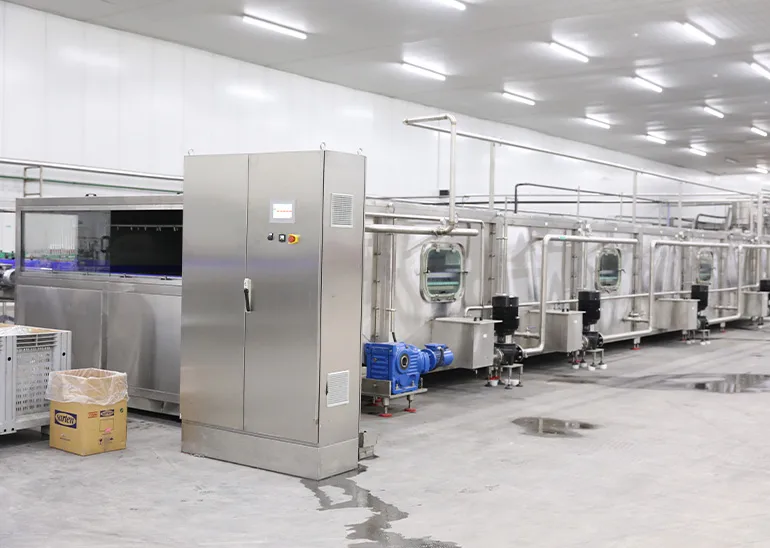
| Types | Shrink wrap, wrap-around carton, carton packing, tray |
| Speed | Matched to the filler; usually the line bottleneck |
| Key control | Film tension, seal temperature, case squareness |
| Material | PE film, corrugated board, tray board |
| Key decision | Shrink, carton or tray |
| Line position | After labelling, before palletizing |
Shrink wrap is the cheapest per case and the fastest, and it suits retail where the pack is the display unit. A wrap-around carton gives print area and stack strength for distribution. A tray with shrink is a compromise used where the pack needs both protection and visibility.
A 4x6 pattern and a 3x4 pattern need different lane guides, different film width and often a different tunnel setting. On a semi-automatic packer the change is manual and takes tens of minutes; on an automatic packer it is a recipe, but only if the pattern was in the original specification.
| Pack format | Cost per case | What it protects |
|---|---|---|
| Shrink wrap | Lowest | Retail display, short distribution |
| Tray + shrink | Middle | Stacking and visibility |
| Wrap-around carton | Higher | Print area and long distribution |
| Regular slotted carton | Highest board use | Fragile packs and export |
Rated output, change parts and services are listed on the Carton Packing page.
From the pack footprint plus the wrap allowance and the tunnel shrinkage. A film that is too narrow leaves the base exposed; too wide and the pack gets a double layer at the seam. Width is a per-format setting, like the lane guides.
Site requirements, air and power consumption sit with the Wrap-round Carton Packer.
Consistent board thickness, a stable score line and a flat stack. A board that varies in caliper jams the magazine and produces wonky cases. The packer is set for one board specification, and a cheaper board is not a saving.
The same question is worked through from another angle in Can One Filling Line Handle PET, Can and Glass?.
Usually insufficient wrap around the base or a seal that opened. Check the film width, the lap position and the seal temperature together, because changing one alone moves the failure elsewhere.
With different lane guides and a film width change, yes. The changeover is mechanical on a semi-automatic packer, so a plant selling both formats usually accepts a scheduled stop between runs.
It is rated in packs or cases per hour and must exceed the filler output in cases. The limiting factor is normally the tunnel dwell time, not the wrapping speed.
Not without a change of the packing module. Shrink and wrap-around carton are different machines with different board or film paths, so a plant running both normally has two packers.



 +86 13921964455
 [email protected]

A2 Dongjiu Industrial Park, 30 East Jintang Road, Tangshi, Zhangjiagang, Jiangsu 215600, China