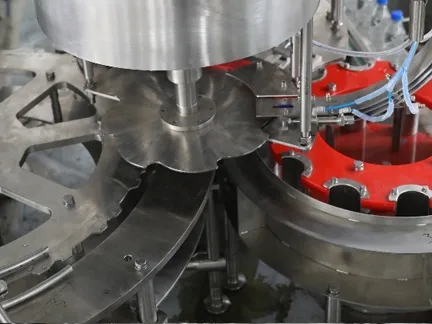
| Stages | Pre-treatment, RO, disinfection |
| Pre-treatment | Multi-media filter, carbon filter, softener |
| RO | Reverse osmosis with a storage and buffer tank |
| Disinfection | UV, ozone, or both |
| Key control | Raw water analysis, recovery rate, conductivity |
| Key decision | Which stages the raw water actually needs |
The raw water analysis decides it. Surface water usually needs multi-media filtration, carbon and RO; hard well water needs softening before the RO; low-hardness municipal water may only need carbon and disinfection. A package bought without an analysis is either oversized or short of a stage.
Meter the intake and the reject stream separately, then divide by production. The ratio between them is the number that moves when recovery improves. Most water-saving projects start with a leak survey and a reject re-use review, not with a new membrane.
| Stage | Removes | Driven by |
|---|---|---|
| Multi-media filter | Suspended solids | Turbidity of raw water |
| Carbon filter | Chlorine and organics | Municipal dosing and taste |
| Softener | Hardness | Calcium and magnesium in the analysis |
| RO | Dissolved salts | Conductivity target of the product |
| UV or ozone | Micro-organisms | Storage time and final barrier |
Rated output, change parts and services are listed on the Water Treatment page.
By permeate flow against filler demand plus the buffer tank volume. The tank covers the RO flush and any short stop; without it, the filler waits on the membrane. Sizing the RO at exactly the filler rate is a common design error.
The specification sheet for the Pre-treatment carries the figures quoted here.
The RO membrane, mainly. Hardness scales the membrane surface, which raises pressure and cuts recovery. A softener upstream is cheaper than a membrane replacement and is sized on the hardness in the water analysis.
The same question is worked through from another angle in The Importance of Water Treatment in Bottled Water Production.
On condition, not on a calendar. Track permeate conductivity, pressure drop and recovery; replacement follows a trend, and a sudden change usually means a pre-treatment failure rather than membrane age.
It depends on the recovery rate set for the feed water. The reject stream is a design output and should be metered, because it is the number that moves when recovery is improved.
RO removes minerals as well as contaminants. Very low-mineral water tastes flat, so some plants blend or re-mineralise to a specification rather than chasing the lowest conductivity.
On chlorine breakthrough and on the supplier recommendation, not on a fixed calendar. A carbon bed that is exhausted lets chlorine reach the RO membrane.
Country: Maldives
Product: PET Bottled Mineralized Water
Capacity: 24,000BPH (500ml); 2 Lines
Solution:Water Production Line
Country:Kazakhstan
Product: PET Bottled Sparkling Water, Canned Soft Drink, Canned Tea
Capacity: 25000CPH (250ml)
Solution:Three Lines,7000BPH(1.5L), 15000CPH(330ml),15000CPH(450ml)



 +86 13921964455
 [email protected]

A2 Dongjiu Industrial Park, 30 East Jintang Road, Tangshi, Zhangjiagang, Jiangsu 215600, China