
| Filling method | Load cell net-weight, or piston dosing |
| Output range | 12,000-36,000 BPH at 0.2-2 L |
| Viscosity | Up to 10,000 cP |
| Accuracy | Plus or minus 0.5 g per bottle |
| Bottle or can | PET or glass |
| Key control | Weight per bottle, temperature, drip-free cut-off |
Four inputs fix the shortlist: the product, the package, the daily demand and the number of formats per week. Everything else, including the brand of the PLC, is a detail that can be settled after those four are written down.
Above a few thousand cP the product moves by pressure and time rather than by gravity, so the bowl, the feed pipe and the valve bore all grow. Temperature control also becomes part of the filling specification, because a cold oil at 10 C and the same oil at 25 C behave like two different products.
Look for fillers equipped with advanced sensors and controls to maintain precise filling levels regardless of the oil's viscosity.
| Dosing method | Accuracy basis | When it fits |
|---|---|---|
| Load cell | Net weight per bottle | Density moves with temperature |
| Piston | Displacement volume | Stable density, high speed, thick product |
| Volumetric valve | Chamber volume | Low-viscosity oil at steady temperature |
| Flow meter | Measured volume | Continuous flow, limited pulp or solids |
Throughput and change-part lists are on the Edible Oil Load Cell page rather than in this note.
With a warm flush and a full drain, because oil does not rinse like water. The circuit needs a low point for drainage and a filter on the return. A change between two oils is quicker than a change from oil to a water-based product.
The Filling Machine for Viscous Product is the matching unit when this becomes a line project.
Nothing, if the filler tares each bottle before dosing. That tare step is what separates net-weight filling from a flow meter. Without it, a heavy bottle delivers less product and the label claim fails.
The same question is worked through from another angle in The Ultimate Guide to Edible Oil Filling Machines: Accuracy.
Yes, with change parts and a recipe. Above 2 L the fill time per valve grows and the practical BPH drops, so the line is normally specified for one dominant format with a second format as a changeover.
Usually air entrained in the product or a fill that starts too fast. Letting the product settle in the bowl and ramping the valve opening removes most of it without changing the pump.
Yes, with a longer fill time per valve. Above 2 L the practical rate per valve drops, so a 5 L line is normally specified for that format rather than shared with 1 L.
Yes, with different infeed parts and a different capping head. Glass brings breakage risk and a lower practical rate, so the two formats are usually run in separate campaigns.
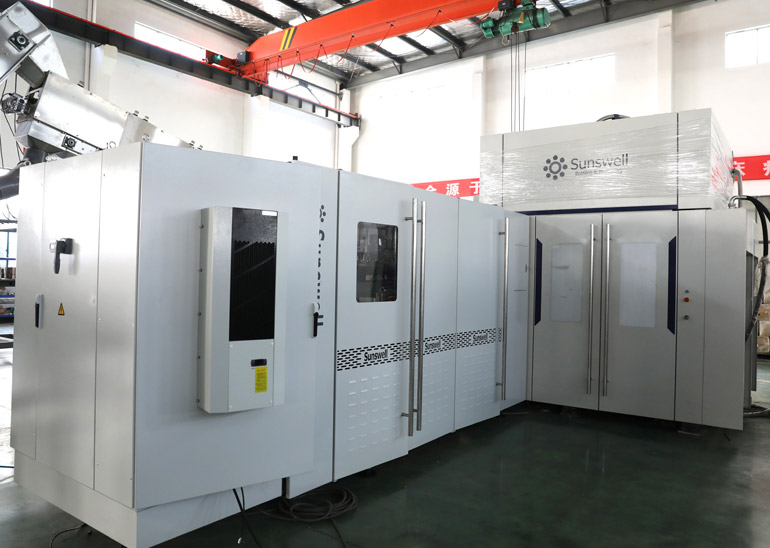
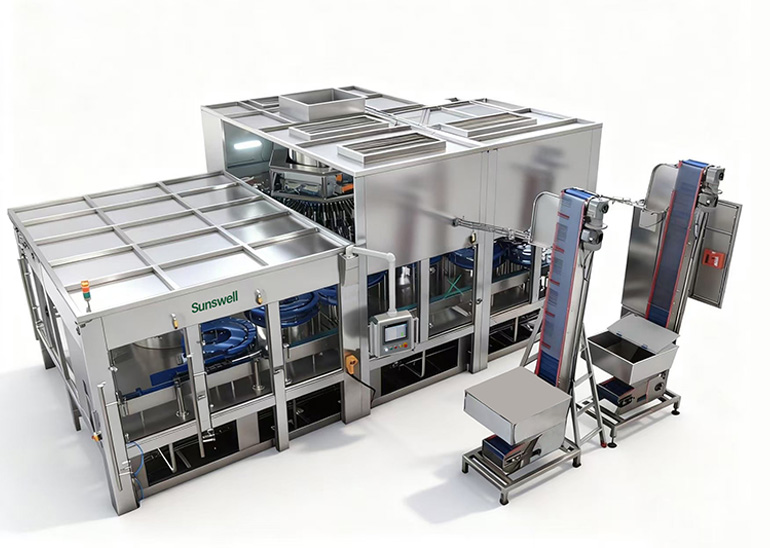
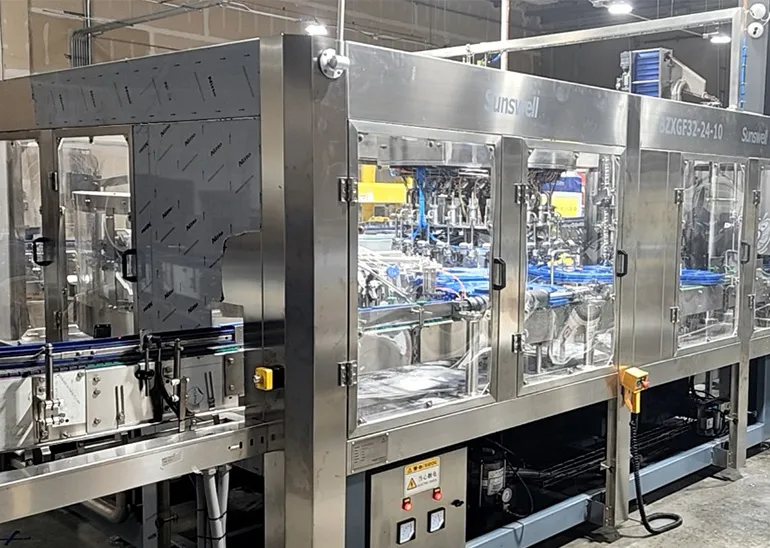
Country: Kazakhstan
Product: PET Bottled Carbonated Soft Drinks
Capacity: 12000BPH (1L)
Solution:Carbonated Drinks Production Line
Country: Maldives
Product: PET Bottled Mineralized Water
Capacity: 24,000BPH (500ml); 2 Lines
Solution:Water Production Line



 +86 13921964455
 [email protected]

A2 Dongjiu Industrial Park, 30 East Jintang Road, Tangshi, Zhangjiagang, Jiangsu 215600, China


