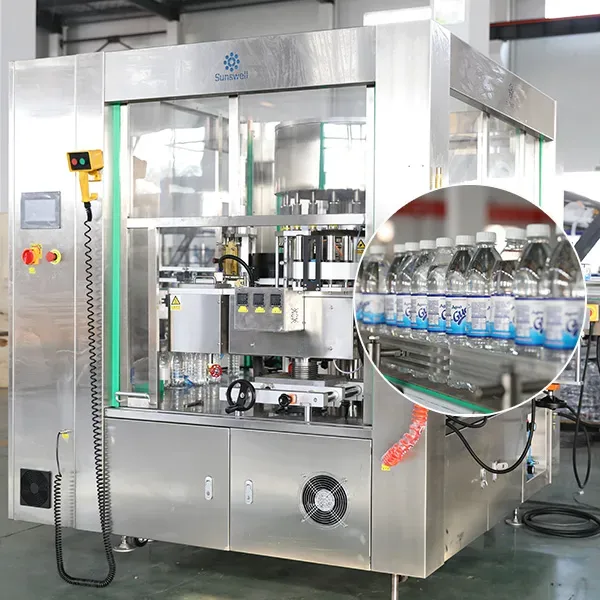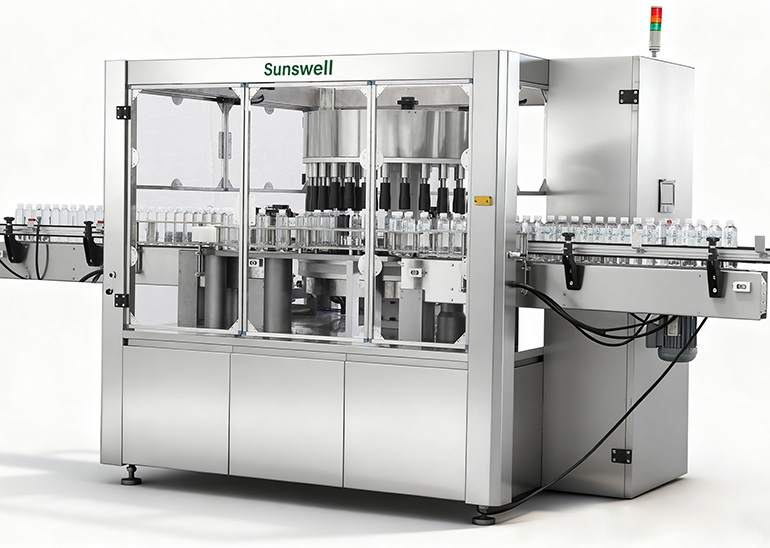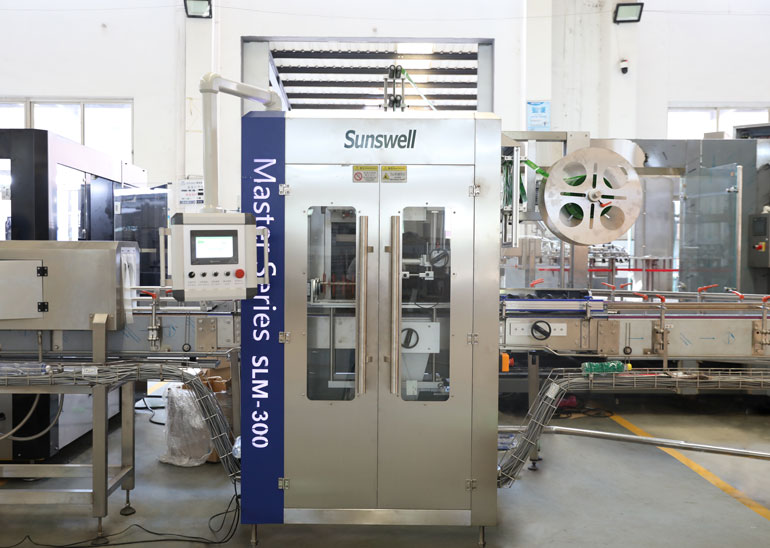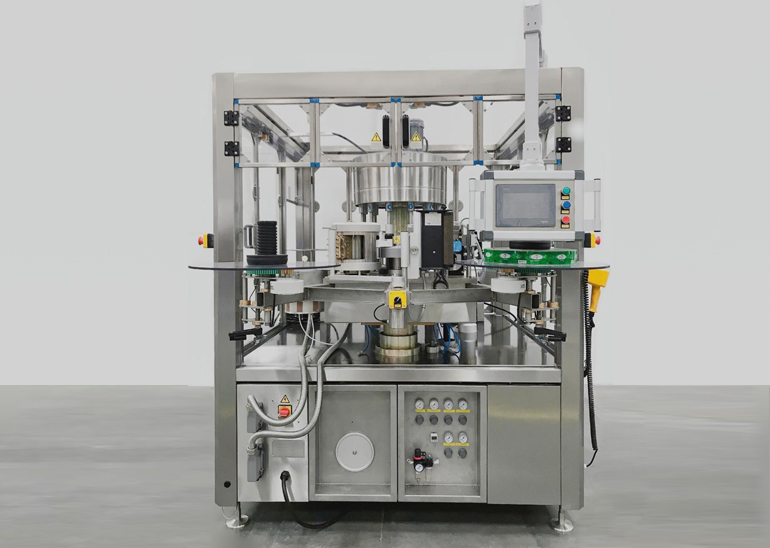
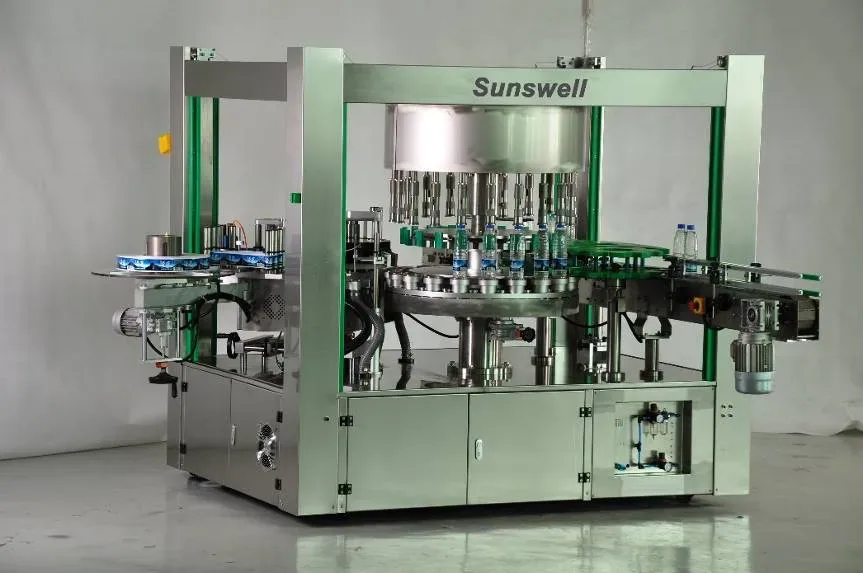
| Types | Sleeve, hot melt glue OPP, rotary sticker, self-adhesive |
| Rate | Matched to the filler, with an accumulator between |
| Key control | Label position, glue pattern, shrinkage, adhesion |
| Contact material | OPP film, PVC or PETG sleeve, paper sticker |
| Key decision | Full sleeve or partial wrap |
| Line position | After filling, before packing |
A full-body sleeve covers the whole bottle and gives the most design freedom, at the cost of film and a shrink tunnel. An OPP wrap-around label is the cheapest per unit at high speed. A sticker suits short runs and curved surfaces where a wrap is impractical.
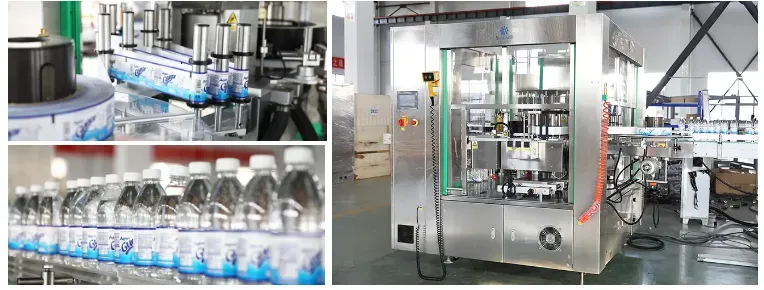
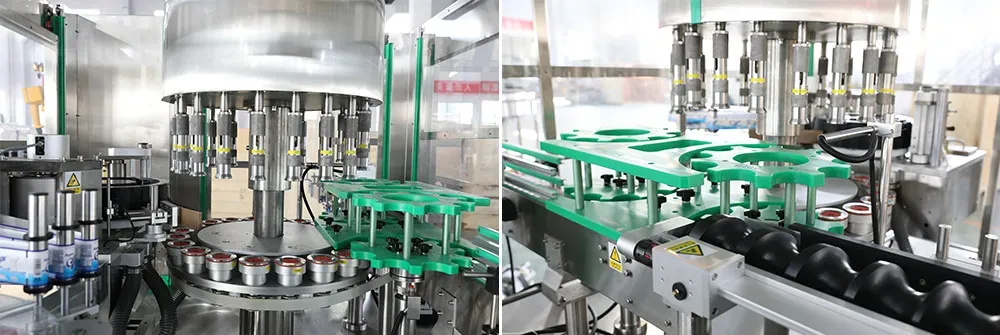
In the cutting unit, the labels are precisely cut while a PLC command and servo-motor provide an exact cut-off point.
The label is positioned relative to the bottle, so any variation in bottle rotation, conveyor speed or label feed shows up as drift. On a round bottle the orientation is set by a roller or a star wheel; on a square bottle it is set by a mechanical aligner. Drift is usually a bottle handling problem, not a label problem.
| Label type | Cost per unit | Best for |
|---|---|---|
| OPP wrap-around | Lowest at volume | High-speed round bottles |
| Full-body sleeve | Higher film cost | Full coverage and shaped bottles |
| Self-adhesive sticker | Middle | Short runs and flat or curved panels |
| Paper label with glue | Low material, slower | Glass bottles and craft products |
The specification sheet for the Rotary Sticker Labeling carries the figures quoted here.
Surface energy, bottle temperature and glue choice. A cold bottle straight from the filler carries condensation, and a water-based adhesive will not bond to it. Hot melt handles a damp surface better, which is why it dominates high-speed beverage lines.
The specification sheet for the Sleeve Labeling carries the figures quoted here.
Because a missing or skewed label is a customer reject that the line cannot see. A camera at the labeller outlet with a reject gate catches it at the source, before the packer hides it inside a case.
The same question is worked through from another angle in Labeling Machines for B2B Beverage Production.
Usually uneven tunnel temperature, wrong film orientation, or a bottle that is still warm from filling. Check the tunnel profile and the film direction before changing the speed.
At high volume, an OPP wrap-around label usually is, because the film is thinner and the machine runs faster. A sleeve costs more per unit but covers the whole bottle and allows full-body design.
Perforation strength, film tension and tunnel temperature act together. A tear that appears after shrinkage usually means the perforation was cut too deep for the film gauge.
Hot melt glue applied at the leading edge, the trailing edge and the seam. The pattern and the pot temperature decide both the bond and how clean the bottle looks.
Country:Kazakhstan
Product: PET Bottled Sparkling Water, Canned Soft Drink, Canned Tea
Capacity: 25000CPH (250ml)
Solution:Three Lines,7000BPH(1.5L), 15000CPH(330ml),15000CPH(450ml)



 +86 13921964455
 [email protected]

A2 Dongjiu Industrial Park, 30 East Jintang Road, Tangshi, Zhangjiagang, Jiangsu 215600, China