Réponse directe : Serbia and Romania offer different legal starting points for a beverage plant: Romania is an EU Member State, while Serbia is an EU candidate country. Choose the site from verified sales routes, source-water suitability, operating costs and the intended destination market. EU sales require a product, packaging and machinery-compliance plan that goes beyond purchasing a CE-marked filler.
The European Commission identifies Serbia as a candidate country. Do not treat expected future accession as an existing operational benefit or use an assumed accession date in a financing model. A Serbian plant serving EU customers needs a defined export and import arrangement, with origin and destination requirements checked for its actual products.
A Romanian plant operates within an EU Member State, but that does not eliminate national factory requirements, product obligations or cross-border commercial costs. The operating company still needs to establish the permissions, controls and documents appropriate to the site and activity. EU location is a planning factor, not a complete approval package.
Start with the customer map. Compare the cost of serving the intended cities or retail networks from each candidate location. Include packaging supply, source access, labor availability, utilities and transport. A lower factory-gate cost can be outweighed by additional finished-goods distance, stockholding or customer service requirements.
| Décision relative au projet | Serbie | Roumanie |
|---|---|---|
| Point de départ légal | EU candidate country; national rules and export route require review | EU Member State; EU framework and applicable national requirements require review |
| Initial sales model | Separate domestic sales from each intended export destination | Separate local distribution economics from wider EU distribution |
| Water-category review | Confirm national category and source permissions; check destination rules for exports | Confirm EU category rules and competent local recognition or approval |
| Financial comparison | Use quoted local costs and transaction-specific customs assumptions | Use quoted local costs and applicable packaging and producer obligations |
Treat both markets as existing beverage-production environments. Do not build the opportunity around an assumption that competitors lack modern filling equipment. A new operator needs a defensible route to customers, a service advantage, a packaging proposition or an agreed contract-packing role that produces repeat orders.
Conduct a shelf and distribution survey by channel. Record the brand, water category or beverage type, bottle material, volume, price per liter, promotions and product origin. Visit the same outlets more than once so an empty shelf is not mistaken for a permanent supply gap. Interview buyers about minimum delivery quantities and payment terms.
For private-label production, obtain technical specifications and the buyer's audit requirements before selecting equipment. A retailer may care about traceability, product release, pack strength and replenishment performance as much as filling speed. A letter of interest is weaker evidence than an executable supply agreement; keep that distinction visible in the capacity forecast.
Natural mineral water and spring water are not interchangeable names for any bottled source water. The European Commission's water-category guidance explains the distinct source and category framework and references Directive 2009/54/EC. Establish the intended category, source recognition and permitted treatments before commissioning the process design.
A purified-water proposal needs a defined finished specification and label identity. A natural-water proposal may impose limits on treatments that alter composition or source characteristics. Do not order RO by default and decide the label later. The process and legal product identity have to be compatible from the beginning.
Provide a representative source report, including the conditions and dates of sampling, to the treatment designer. Confirm available flow and seasonal variation. Ask for the process rationale, guaranteed outlet quality, feed limits, cleaning approach and water balance. Sunswell's Système de traitement de l'eau can be evaluated against those duties without assuming that every offered treatment is appropriate for every water category.
Still water and carbonated drinks require different filling duties. A water proposal starts with source quality, hygienic handling and the selected bottle and closure. A CSD proposal adds recipe preparation, carbonation, chilling and pressure-related packaging behavior. Compare the complete process rather than assuming that a different valve arrangement is the only change.
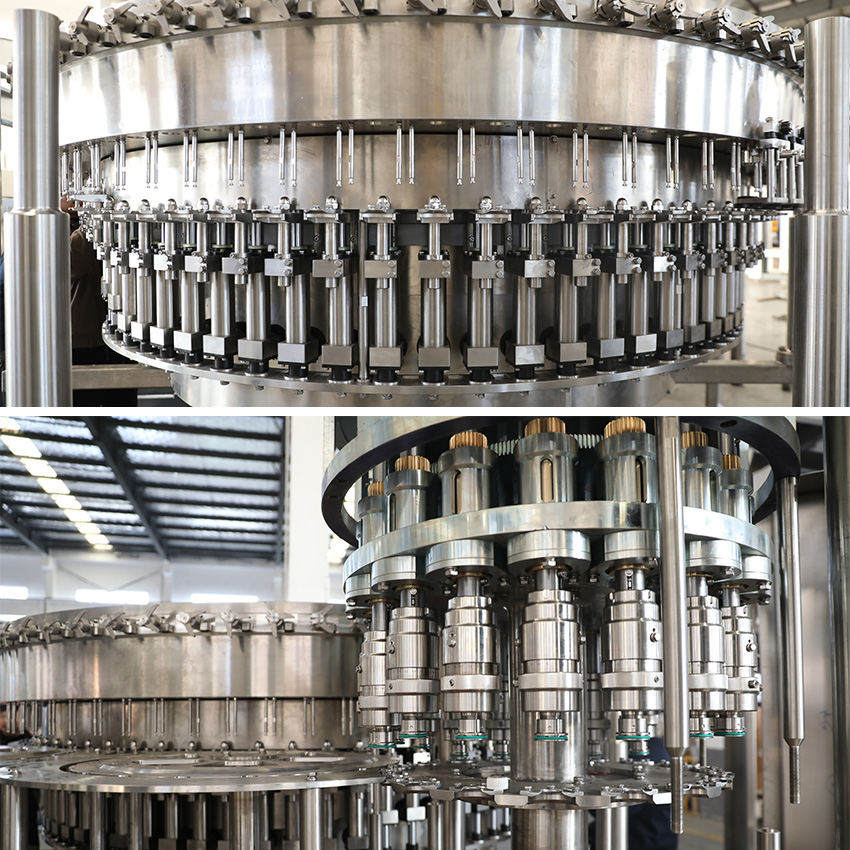
For the water scope, review the ligne de production d'eau from bottle supply to final pack. For CSD, assess the ligne de production de boissons gazeuses with agreed product temperature, carbonation target and package performance. Ask suppliers to identify which requirements constrain maximum speed and which need additional utility equipment.

If both products will use a shared line, define cleaning and product-change procedures. Consider aroma carryover, recipe identification, packaging changes and the time needed to return to stable production. Allocate those losses in the production calendar. A flexible system that spends excessive time changing products may be less economical than a narrower launch scope.
Approve the bottle, cap, label and code as one package system. Confirm the neck finish, closure application, bottle stability, label position and scanner readability. Check transport compression and pallet behavior with the intended pack. Lightweighting should follow qualification, rather than a material-weight target disconnected from distribution conditions.
Romania's deposit-return system is a further packaging workstream. RetuRO describes a 0.50 RON deposit for eligible beverage packaging and explains the system's operation. Use the RetuRO guidance and the current producer requirements to confirm registration, eligible packaging and marking before artwork and coding systems are finalized. Do not assume that an ordinary barcode alone satisfies every requirement.
EU packaging rules are also changing on a phased schedule. The Commission states that the Packaging and Packaging Waste Regulation begins applying in phases from 12 August 2026. Consult the Commission's application notice and check the date for each relevant obligation. A rule's general application date does not mean every future target or marking measure applies immediately.
Set the applicable framework from the intended date machinery is placed on the EU market and the actual configuration. The Commission states that the Machinery Regulation applies mandatorily from 20 January 2027, replacing the current Machinery Directive. A project ordered in 2026 but delivered later must therefore resolve the transition deliberately. See the official machinery guidance.
Define who is responsible for conformity of the assembled line, including conveyors, guards, control interfaces and safety functions. A collection of component declarations does not, by itself, answer the integration question. Ask for the relevant documentation, instructions, risk-assessment responsibilities and validation evidence for the supplied assembly.
Keep machinery conformity separate from beverage safety, food-contact suitability and factory operation. Review cleanability, product-contact materials, traceability and sanitation procedures in the relevant technical files. Ask for evidence applicable to the proposed materials and duty instead of relying on a logo in the sales brochure.
Use a product-format matrix with monthly demand, peak requirements, scheduled production hours, sanitation and changeovers. Convert sales into saleable packs per shift, then work backward to the required nominal rate using a stated production factor. Verify the rate on each format; a small-bottle BPH figure cannot establish a large-bottle guarantee.
Compare offers on the same boundaries: water treatment or beverage preparation, bottle supply, filling, coding, labeling and packing. Include utility equipment, local installation resources, maintenance access and working capital. Evaluate the cost per saleable pack under a conservative schedule, rather than ranking machines by their purchase price alone.
At acceptance, run representative packaging and products through the complete line. Measure finished output, rejects, fill consistency, closure integrity and code readability over an agreed period. Record utilities and operating conditions. Require a deviation list and corrective-action evidence so the handover is based on demonstrated performance.
For a staged launch, write expansion triggers into the operating plan. Examples include sustained use of the existing shift, confirmed orders beyond current capacity or a documented packing bottleneck. Reserve sensible layout space and service access, but do not purchase speculative speed solely to obtain a lower quoted cost per nominal bottle. Compare the added capacity with additional shifts, maintenance downtime and the working capital needed to sell and distribute its output. The expansion decision should follow evidence from the actual plant and customer network.
No. Treat Serbia's candidacy and Romania's EU membership as different current conditions. Confirm the actual export route and product requirements instead of assuming future accession benefits.
No. Machinery conformity, food-product compliance, source recognition where relevant and packaging obligations are separate workstreams.
Possibly, but artwork, deposit-system requirements, language and destination rules must be checked. Qualify the physical package and the market-specific information separately.
Compare serviceable demand and source suitability, then a consistently scoped delivered-cost model. Request machinery quotations after those project assumptions are sufficiently defined.



 +86 13921964455
 [email protected]

Parc industriel A2 Dongjiu, 30 East Jintang Road, Tangshi, Zhangjiagang, Jiangsu 215600, Chine