
Réponse directe : An Iraq turnkey bottling project needs an agreed product scope, a verified utility envelope and a responsibility matrix from water intake to saleable pack. Specify what the supplier delivers, what the owner prepares and what acceptance tests prove. Confirm product approvals and machinery-import requirements separately; the word “turnkey” does not make either automatic.
Translate the word into measurable boundaries. State whether the package begins at raw-water intake, a prepared-water connection or a beverage tank outlet. State whether it ends at a capped bottle, a coded and labeled pack or a wrapped pallet. List every transfer point and identify who supplies the connecting pipework, controls and services.
For a turnkey bottling plant in Iraq, the useful deliverable is a functioning system under agreed site conditions. A supplier can deliver every machine on its list and still leave a gap at the compressor, cooling-water circuit or product-transfer pipe. Those interfaces need an owner before the layout and price are fixed.
Separate supply, installation, commissioning and process validation. The party assembling equipment may not be the party validating beverage safety or obtaining local approval. Record the required evidence and sign-off for each workstream. Avoid assigning a responsibility simply to “the project team” when a delay or failure would require one party to act.
| Interface | Information requise | Responsibility to state |
|---|---|---|
| Water source to treatment | Available flow, analysis, pressure and permitted access | Source connection, testing and treatment design |
| Utility plant to machines | Power quality, air duty, cooling duty and operating conditions | Supply equipment, distribution and performance verification |
| Prepared beverage to filler | Product properties, temperature and hygienic connection | Processing, transfer, cleaning and validation |
| Filled bottle to finished pack | Pack design, label, code and pallet requirements | End-of-line integration and rejection |
| Delivery to commercial operation | Site readiness and acceptance protocol | Installation resources, training and close-out |
Choose the launch product from documented customer demand and local supply capability. Still water, juice and CSD require different process systems. A broad Iraq beverage market opportunity does not establish the recipe, bottle or shelf life on which equipment can be guaranteed. Start with the product expected to provide repeat sales, then list future products separately.
For water, confirm the source and permitted product identity. For juice, supply the formulation or a controlled description of acidity, pulp and viscosity and identify the qualified process specialist. For CSD, add carbonation and fill-temperature requirements. State whether distribution is ambient or chilled and what shelf-life evidence will be required before sale.
Évaluer un complete water production line on the agreed water duty. If carbonated beverages form the initial business, use a carbonated drinks line specification instead. Combining products in one enquiry is reasonable, but ask suppliers to distinguish shared equipment from product-specific modules and to quantify changeover time.
Identify the competent authorities for the factory, source, food products and site. Create a document register covering business details, site information, water testing, formulations, labels and inspection evidence as applicable. Obtain the current requirements from the responsible authority or local specialist rather than adopting a generic international certificate list.
Iraq's Central Organization for Standardization and Quality Control, COSQC, publishes standards-related services, including technical requirements and product conformity activities. Use the official COSQC service catalogue to identify the correct enquiry route. The existence of a conformity program does not establish that every filling machine or ingredient shipment follows the same procedure. Confirm coverage using the actual product and HS classification before shipping.
Where halal status matters to a beverage formulation, check ingredients, processing aids, customer requirements and the accepted certification route. Do not write “halal-compliant plant” into the contract without defining what evidence it requires. An equipment declaration is not a substitute for checking the actual ingredients and production controls.
Obtain a site survey with the available electrical supply, observed interruptions and planned backup arrangement. Build a load list from individual machines and utility equipment. Include running demand, starting demand, simultaneous operation and any limits imposed by drives or control systems. Ask qualified electrical specialists to design protection and grounding for the installation.
The compressor, chiller and heating system can alter the backup requirement much more than the filler motor. A statement that “the bottling machine runs on a generator” is therefore insufficient. Specify which systems must remain operating, which can stop safely and how a controlled restart will be performed.
Use the electrical envelope in acceptance testing. Verify that undervoltage, power loss and restart do not cause uncontrolled product release or unsafe automatic motion. The required response should be designed and documented; this is not an invitation to interrupt live equipment without an agreed test procedure. Record operator actions and product disposition after an interruption.
Supply the treatment designer with representative source-water results and the required finished specification. Agree the permitted feed envelope, output quality, flow, recovery and monitoring plan. Make sure the design covers pretreatment, sanitary storage and distribution to the filler, including cleaning and sampling access.
Le Système de traitement de l'eau should be evaluated together with the production calendar. If source availability is intermittent, determine the necessary raw-water buffer and its hygiene controls. If treatment runs longer than the filler, calculate treated-water storage from the actual hourly balance. Do not size tanks by an unexplained rule of thumb.
Plan how reject water and cleaning wastewater will be handled under the site's requirements. Assign pipework, drainage, chemical storage and any effluent treatment explicitly. A project described as “source to bottle” can still exclude wastewater works, so the contract should state where that responsibility ends.
State the required saleable packs per shift for each principal format. Include scheduled hours, product changes, sanitation periods and the assumed production factor. An illustrative 6,000 BPH line running eight scheduled hours at a 60% combined production factor yields 28,800 saleable bottles per day. This is a planning calculation, not a recommended Iraq capacity or a performance guarantee.
Ask for a bottleneck schedule covering bottle supply, preparation, filling, capping, coding, labeling and packing. A fast filler with a slow packing station cannot produce its nameplate rate as saleable output. Specify finished-pack inspection and how rejected bottles will be removed and recorded.
Define test duration and conditions in the contract. Identify the product, bottle, cap, label, packaging materials and utility conditions. Measure output, rejects, filling consistency and closure integrity using agreed methods. Include controlled format-change tests where changeovers materially affect the production plan.
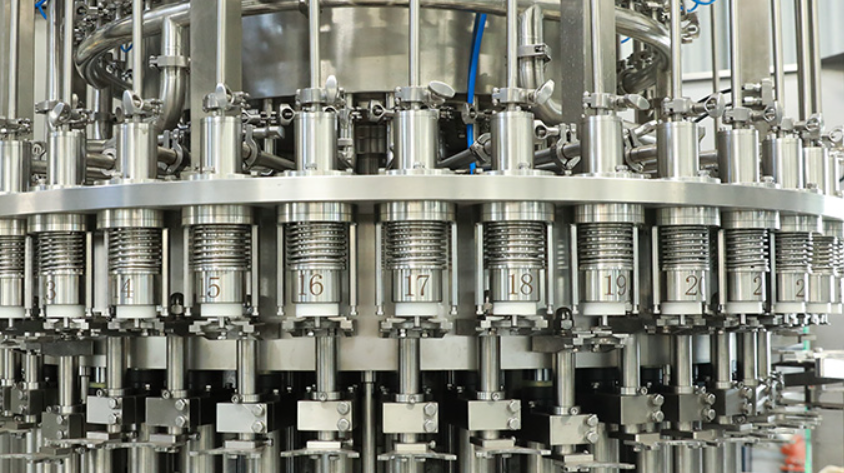
Rotary filling valves and bottle-handling components inside Sunswell water filling equipment. Photo: Sunswell official website.
Request equipment drawings, electrical diagrams, utility schedules, manuals, parts lists and a clear software-backup arrangement. Agree the language needed for operators and maintenance staff. Identify documents that must be approved before manufacture, documents required before shipment and records due after commissioning.
Build the initial spare-parts list from failure consequences and replenishment lead times. Distinguish consumables, wear parts and components whose failure stops the line. Record manufacturer references and compatible revisions. A box described only as “free spare parts” is difficult to audit and may contain little that can recover a major stoppage.
Training should include start-up, shutdown, sanitation, format change, alarms and first-line fault diagnosis. Define who attends and how competence is checked. Ask the supplier to show the route for technical escalation, remote access if applicable and parts ordering, without assuming a local service presence that has not been confirmed.
Use a sequence tied to evidence: agreed requirements, approved layout, verified site readiness, factory acceptance, shipment release, installation completion, site acceptance and operating handover. Assign a decision owner to each milestone and record the evidence needed to pass it. Keep unresolved deviations visible until they are closed.
Before shipment, confirm that the building, utilities and unloading route can accept the equipment. Check door dimensions, lifting arrangements, floor loading and installation access with qualified personnel. Store machinery under the agreed preservation conditions if installation is delayed. Project readiness often determines whether delivered equipment becomes production capacity promptly or remains an idle asset.
No. Include them only when they are explicitly listed with design duties, installation scope and acceptance responsibility. Ask for a priced exclusions schedule.
Not necessarily. Compare equivalent boundaries and include missing utilities, local works, installation resources and working capital before ranking offers.
Only defined products and conditions can support a meaningful guarantee. Treat untested future formulations as a separate qualification task.
Provide the site, product category, water analysis, target formats and output, utility survey and proposed project boundaries. Ask for a marked-up responsibility matrix before requesting a final turnkey price.



 +86 13921964455
 [email protected]

Parc industriel A2 Dongjiu, 30 East Jintang Road, Tangshi, Zhangjiagang, Jiangsu 215600, Chine


