
Respuesta directa: Enter Algeria or Morocco with a country-specific plan for the water source, beverage category, factory approvals and distribution channel. A 5 L or returnable large-container format is a separate operating decision, not a shortcut to market access. Compare the countries using verified local permissions and delivered production costs, then qualify the packaging and filling process before committing to the line.
Algeria and Morocco can be discussed together for regional commercial planning, but a factory in one country does not establish approval in the other. Identify the local operating company, intended customers, customs route and source-water rights separately. A shared language in a sales presentation does not produce a shared permit or technical file.
Begin with a channel map. List the outlets that will actually carry the product, their delivery radius, credit terms and competing packs. Determine whether the entrant intends to compete in everyday drinking water, a source-defined premium category, juice or a formulation-based drink. Each choice changes the production and sales assumptions.
A large national population or a hot-weather demand narrative is insufficient evidence for a specific plant. Request distributor records or conduct a documented outlet survey. No verified, like-for-like dataset for 5 L and 20 L pack shares in both countries was established for this guide. Those sizes are therefore evaluated as options, without claiming that either dominates the local market.
Define whether the product is natural mineral water, spring water or another permitted drinking-water category before selecting treatment. A source-defined identity may restrict changes to composition or treatment. A process designed to produce purified water cannot automatically support a natural mineral-water label simply because minerals are present in the finished bottle.
Algeria's Ministry of Commerce publishes the framework covering exploitation and protection of natural mineral and spring waters, including the 2004 decree and its 2013 supplement. This makes source recognition and exploitation a separate question from filler selection. Start with the official Algerian regulatory reference and obtain the applicable current requirements for the specific site and product.
Morocco's ONSSA beverage-regulation pages distinguish water-related rules from juice, nectar and other non-alcoholic beverage provisions. Use the ONSSA beverage regulation index to identify the category, rather than applying one generic beverage checklist. The exact dossier and permitted process require local confirmation.
| Concepto del producto | Decision before equipment quotation | Consequence for plant design |
|---|---|---|
| Source-defined mineral or spring water | Establish recognition, source rights and permitted treatments | Protect source identity and avoid unjustified composition changes |
| Agua potable tratada | Define the finished specification and label category | Select pretreatment and separation from source analysis |
| Juice or nectar | Define legal identity, formulation and preservation | Include ingredient handling, processing and validated filling conditions |
| Returnable bulk water | Define container ownership and reuse policy | Add return inspection, washing, segregation and rejection |
Make a matrix for the operating company, site permissions, source access, food-facility approval, product and label review, and equipment import. For each item, identify the responsible organization, evidence, cost basis and dependency. Do not assume all approvals can be obtained before the site is equipped, or that every application must wait until commissioning.
For Morocco, ONSSA publishes procedures that include authorization or approval of food establishments and water-use monitoring. Its code-of-procedures page is a useful entry point for confirming the correct process. Imported food controls and machinery import are different scopes; ask the importer to identify which requirements apply to each shipment.
For Algeria, obtain current written advice on the imported equipment, components and consumables rather than extrapolating from a previous transaction. Record the HS classification, importer, payment documentation and shipment requirements. The purpose is to turn “customs clearance included” into a list of tasks and responsibilities that can be checked before dispatch.
Compare formats on contribution per delivered pack and per delivered liter. Small packs can fit convenience and hospitality channels but require more closures, labels and handling units per liter. Large packs reduce the number of packs for a given volume while changing carrying, palletizing, retail space and delivery requirements. Neither trade-off establishes demand by itself.
For a purely illustrative comparison, 10,000 liters equals 20,000 bottles at 500 ml or 2,000 bottles at 5 L. The tenfold difference in container count does not imply a tenfold reduction in labor or packaging cost. Larger bottles need different material, handling and pack-stability checks, and the line may run at a different BPH.
Pregunta la línea de producción de agua supplier for separate output and utility figures for each approved bottle. Obtain drawings and samples early. Confirm the practical changeover scope, including bottle guides, starwheels, cap application, label handling and final packs. A 5 L addition may need a dedicated configuration rather than ordinary small-bottle adjustments.
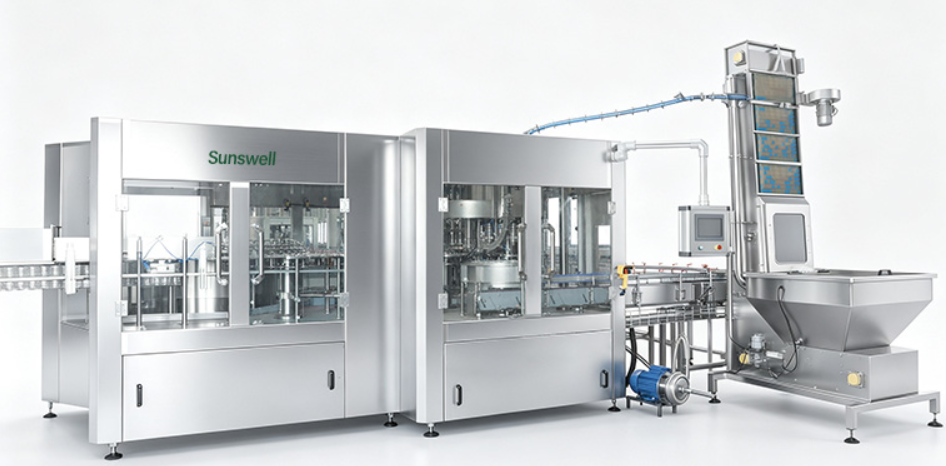
Sunswell enclosed water rinsing, filling and capping equipment. Photo: Sunswell official website.
Returnable 20 L-class containers add another business system. Include container deposits or ownership, damaged-container losses, collection routes, dirty-bottle storage and washing verification. Keep returned containers away from clean packaging flows. A small-bottle PET machine does not cover those operations merely because the catalogue uses the term “water line.”
Commission a representative water analysis and assess seasonal supply quantity. The required tests should be selected by a competent laboratory and process specialist for the actual source and finished-water standard. A coastal location, an inland location and a municipal connection are not interchangeable engineering inputs.
Use the report to justify filtration, membrane separation or other appropriate steps. Ask for the expected outlet quality, feed limits, water recovery, consumables, cleaning procedures and reject-water arrangements. Discuss Sunswell's equipo de tratamiento de agua through these duties. Verify permitted treatment for a natural-water category before applying a purified-water process.
Include water consumed outside the bottles. Rinsing, cleaning and utility systems can alter the site's total demand and wastewater profile. Meter major uses separately where practical. A water balance gives a more useful basis for comparing designs than a statement that a system is “water saving” without an operating condition or reference measurement.
Distinguish a fresh-fruit project from a concentrate or puree-based beverage. Fresh fruit requires receipt, sorting, washing, extraction and by-product management. A prepared-ingredient project still needs controlled storage, batching accuracy and traceability. Establish the recipe and product identity before selecting tank sizes and pumps.
Match the preservation process to acidity, pulp, intended shelf life and distribution conditions. Have the process established and validated by qualified specialists. For hot filling, verify the full package's thermal suitability. For an aseptic system, examine the sterile boundary, packaging treatment, cleaning and validation responsibilities rather than accepting the machine name as proof.
El línea de producción de jugo enquiry should identify the most demanding intended product and the evidence needed to demonstrate it. Reserve future expansion interfaces when economical, but keep the initial capital scope linked to real launch volumes. An unused juice module creates maintenance and working-capital demands before it creates sales.
Request comparable offers covering source handling, treatment, bottle supply, filling, coding, labeling and packing. Then add local works, utility systems, freight, import charges, installation resources and commissioning materials. Record who supplies packaging for trials and who pays for repeat tests if a component fails.
Model the launch stock and customer credit terms alongside machinery cost. A beverage plant can have technically adequate capacity and still run out of cash while financing packaging and distribution. Compare a conservative first-stage configuration with a clearly priced expansion, using the same production calendar and saleable-output calculation.
Run sensitivities for lower repeat orders, increased packaging cost and longer inbound lead times. Do not publish a universal “Maghreb plant price” or a fixed payback period without a dated configuration and commercial assumptions. The valuable result is a comparable project model with visible uncertainties and assigned actions to resolve them.
Before choosing a supplier, have the local project team review the comparison model and identify unresolved assumptions that could change the site decision. Replace provisional freight and installation allowances with written quotations as the design develops. Keep the commercial launch date separate from the machinery shipment date; product testing, approvals and distribution readiness still need time and assigned owners.
Do not assume mutual acceptance. Confirm the relevant factory, product, source, label and import requirements for each country and transaction.
Only if the target customers, delivered margin and packaging supply support it. Compare actual outlet evidence with the cost and handling requirements before adding the format.
Product identity depends on the applicable rules and source recognition, not a marketing preference. Confirm the category and permitted treatment before using that description.
Provide the country and site, water analysis, intended product category, bottle and closure drawings, sales-based output target, utility conditions and required delivery format. Ask for explicit exclusions and a format-specific acceptance plan.



 +86 13921964455
 [email protected]

Parque industrial A2 Dongjiu, 30 East Jintang Road, Tangshi, Zhangjiagang, Jiangsu 215600, China


