
الإجابة المباشرة: To set up a bottled water and juice plant in Egypt, establish the site and product approvals, test the intended water source, define each beverage's preservation process and calculate the full utility load before ordering equipment. RO configuration must follow a water analysis and product specification. A water line and a juice line may share infrastructure, but their processing and hygiene requirements need separate validation.
Start with a project definition covering the proposed location, legal operator, water source, product categories, packaging and customers. Decide whether the initial scope is purified drinking water, a recognized natural-water category, juice from concentrate, nectar or another beverage. Those identities affect permitted treatments, ingredient handling, labels and the evidence needed to release product.
Use Egypt's National Food Safety Authority registration portal as a starting point for establishing the food-facility route. Identify the other permissions that apply to the site and activity with the relevant local authorities. Factory registration, water abstraction, environmental requirements and machinery import should appear as separate workstreams in the project schedule.
GOEIC's role in export and import control should not be confused with a universal certificate authorizing beverage manufacture. Confirm the import route for the actual equipment and consumables, including classification and importer responsibilities. Ask the broker to list the required shipment documents before the purchase contract fixes packing and dispatch dates. The GOEIC service portal provides an official contact route for that clarification.
Test the actual production source. “Municipal,” “groundwater” and “Nile-related supply” describe origins, not usable engineering specifications. Different extraction points, treatment systems, distribution networks and seasons can produce different feed characteristics. A generic analysis from another Egyptian plant cannot justify the membrane design at the new site.
Collect representative samples through a competent laboratory and identify the sampling point on a site drawing. The engineering review should cover microbiological quality, suspended matter, conductivity, hardness, alkalinity and relevant dissolved constituents. The laboratory and process specialist should select additional tests from the source risk assessment and the intended finished-water requirements.
Obtain more than a single certificate if the source changes materially through the year. Review available supply records and conduct additional sampling where the risk warrants it. Also verify the quantity available during the operating window. A compliant sample does not establish that the source can reliably supply the required flow while the surrounding site demand is highest.
Specify the target treated-water quality first. The required separation, feed composition, temperature and recovery objective then guide pretreatment and membrane selection. Ask for a membrane projection, the assumptions behind it, fouling and scaling controls, cleaning arrangements and the proposed monitoring instruments. Review these with the supplier against the source report.
| Feed or product condition | سؤال هندسي | الإجراء التالي المناسب |
|---|---|---|
| Variable suspended solids | Can pretreatment maintain the required membrane feed quality? | Establish filtration duty and monitoring from representative samples |
| Significant scaling potential | What limits recovery and cleaning frequency? | Review chemistry, pretreatment and the membrane projection |
| Product needs lower residual dissolved constituents | Can one pass meet the finished specification consistently? | Compare projected results and verify whether a second pass is justified |
| Recognized natural mineral-water product | Which treatments preserve the permitted category? | Confirm legal treatment limits before selecting RO |
RO stages and RO passes are different concepts. Staging membrane vessels within a pass can support recovery and hydraulic design. A second pass treats the permeate again to meet a different quality objective. Asking for “two-stage RO because Egypt needs it” skips the actual engineering question. Define the outcome rather than prescribing a vague machine label.
Sunswell's نظام معالجة المياه can be discussed as part of the source-to-filler design. Ask for the guaranteed outlet conditions, the feed envelope within which they apply and the responsibility for rejected water. Do not treat a catalogue capacity as a completed site design.

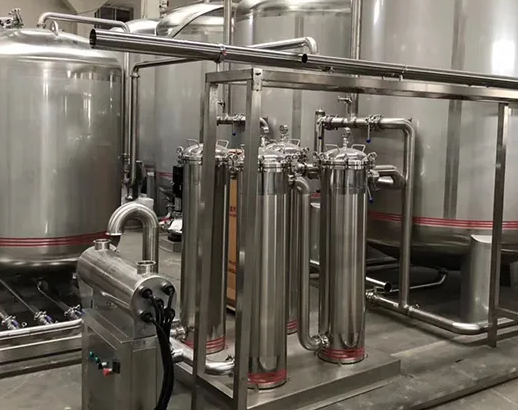
Stainless-steel tanks, filters and pipework in a Sunswell water treatment installation. Photo: Sunswell official website.
First calculate the maximum packaged-water demand at each format's contractual line speed. An illustrative 5,000 BPH water line filling 500 ml bottles requires 2,500 liters per hour in the bottles while running at that rate. Add separately justified allowances for rinsing, cleaning and other uses; do not hide all consumption inside an unexplained percentage.
If the illustrative RO permeate duty is 3,000 liters per hour and assumed recovery is 70%, raw feed is approximately 4,286 liters per hour and reject is approximately 1,286 liters per hour. These are arithmetic examples, not recommended site settings. Actual recovery depends on water chemistry, membrane design and operating conditions.
Choose storage from the supply and operating profile. A large untreated-water buffer can stabilize availability, but tanks and pipework still need suitable construction and cleaning access. Treated-water storage requires a hygienic design that controls contamination and residence time. Coordinate treatment operation, filler demand and sanitation periods so the buffer solves a defined mismatch rather than becoming unnecessary stagnant volume.
A small-bottle project normally requires a defined bottle-supply route, rinsing or another justified container-preparation method, filling, capping, coding, labeling and final packing. Add inspection and reject handling at the points where defects can be reliably detected. Determine whether purchased empty bottles or in-house blowing best fits local supply, storage and production volume.
Compare a separate blower and monoblock with an integrated configuration using the same bottle and output basis. Include compressor load, bottle transfer, operator access and maintenance capability. The relevant خط انتاج المياه proposal should show the complete package flow and the equipment that limits output on each format.
A large-container or returnable-water business needs its own process review. Dirty-container receipt, inspection, washing and rejection create different layout and hygiene questions from those of new PET bottles. Do not add a bulk-water product to a small-bottle line merely by listing a second bottle size in the quotation.
Define whether the plant will process fresh fruit or receive concentrate, puree or prepared ingredients. Fresh-fruit handling adds raw-material variability, washing, extraction and by-product management. A concentrate-based beverage still needs controlled storage, batching, mixing and traceability. Write a mass balance for the actual recipe before estimating tanks and pumps.
Have a qualified process specialist establish the preservation process from the formulation, acidity, particulates, desired shelf life and storage conditions. Hot filling, chilled distribution and aseptic processing are different system choices. Do not transfer a temperature or holding time from another recipe and call it validated. Bottle, closure and filling conditions must fit the selected process together.
استخدم خط إنتاج العصير discussion should include mixing, thermal treatment where needed, filling, cleaning and the interfaces between them. Request evidence that the proposed product-contact components handle the intended pulp and viscosity. Agree the responsibilities for recipe development, process validation and shelf-life testing; these do not disappear because one vendor supplies several machine
Enclosed Sunswell juice filling equipment shown on the official product page. Photo: Sunswell official website.
Map the movement of raw materials, people, packaging, finished goods and waste. Keep dirty receipt activities from crossing open-container or product handling without an appropriate control. Provide access for cleaning, inspection, filter changes and major component removal. Leave adequate space around tanks and skids rather than drawing only their equipment footprints.
Shared utilities can reduce duplication, but their design must reflect concurrent demand. A compressor that supports bottle blowing may dominate the electrical load. Juice heating and cleaning can change hot-water or steam demand. Wastewater quantity and composition also change when product losses, wash water and cleaning chemicals enter the system. Egypt's EEAA beverage-industry guidance is a useful environmental starting reference; confirm the requirements for the selected site.
Agree a written acceptance plan before manufacturing starts. Test each principal bottle format and the most demanding approved product. Measure saleable finished packs, fill consistency, closure integrity, coding readability and reject handling over an agreed run. Record utility conditions during the test so the result can be interpreted against the contractual basis.
Water quality should be checked at the defined process points and in the packaged product. For juice, complete the required process and microbiological validation before making the promised distribution or shelf-life claim. Train operators in sanitation, product changeovers and controlled restart after interruption. Deliver a traceable record of deviations and corrective actions before closing acceptance.
Do not assume so. Select the treatment from the source analysis, finished specification and legally permitted water category. Those factors must be established before the process is fixed.
Only when its construction, cleaning system, process conditions and packaging interfaces are suitable for both. Obtain written confirmation for the exact products and include both duties in acceptance testing.
Average sales alone are insufficient. Check instantaneous demand, production hours, storage, cleaning and the source's available flow.
Send the water report, site layout, proposed products, bottle and cap samples, production calendar and utility survey. State which approvals and process-validation tasks already have an assigned owner.



 +86 13921964455
 [البريد الإلكتروني محمي]

A2 Dongjiu Industrial Park، 30 East Jintang Road، Tangshi، Zhangjiagang، Jiangsu 215600، الصين


