
Прямой ответ: Argentina and Chile should be evaluated as separate beverage-production investments. Argentina is a MERCOSUR State Party, while Chile is an Associate State; that distinction does not by itself determine a project's tariff treatment or food approvals. Select the production base from verified customer demand, local permissions, packaging supply and delivered operating cost, then specify a water or carbonated-drink line for the chosen product.
Нет. official MERCOSUR country list distinguishes Argentina's membership from Chile's associate status. A business plan should therefore avoid treating “Argentina and Chile” as one customs location. Check the applicable agreement, product classification, origin rules and destination requirements for every intended export flow.
Manufacturing locally and importing finished beverages are also different projects. The importer of a packaged drink needs a compliant product and import route. The operator importing production machinery needs a correctly classified shipment, installation plan and locally approved food-manufacturing operation. One set of documents does not automatically satisfy the other.
Before comparing countries, define where the first customers are, which entity will invoice them and how the finished goods will travel. A theoretical tariff advantage has limited value when the additional delivery distance or stock requirement consumes the margin. Obtain written customs advice for the actual transaction rather than applying a regional slogan to a capital purchase.
The relevant opportunity is a serviceable segment: an underserved delivery route, a confirmed private-label contract, a regional retail listing or a product with repeat demand. Record the competing pack size, price per liter, promotion pattern and payment terms. Distinguish retailer sell-through from the opening shipment requested by a distributor.
An Argentina beverage market model should test local-currency sales against the currencies used for packaging, ingredients, equipment financing and replacement parts. Use quoted purchasing terms and a dated exchange-rate assumption. Model inventory and receivables as cash requirements; an accounting margin does not guarantee enough cash to replenish imported components.
Industry-wide growth or consumption claims need a defined category and date. For this guide, no consistent country-pair dataset was verified that separates the exact still-water and CSD segments a new entrant would serve. Build the investment case from documented channel volumes and treat broader forecasts as context only. Avoid applying a beer-market forecast to a bottled-water line.
For Argentina, identify the establishment and product registration route with the competent authority and obtain the current labeling requirements for the actual beverage. ANMAT's COMEX INAL portal provides the starting point for food import and export procedures. Imported food rules have changed, so an older supplier presentation should not be used as the project checklist.
For a Chile bottling plant, establish the sanitary authorization route before committing to the building layout. ChileAtiende describes authorization for facilities that produce, process, pack, store or distribute food. Its guidance says the premises must be equipped and meet the regulatory conditions when the application is made. Use the official food-facility authorization guidance to frame the local discussion, then confirm the current submission requirements.
| Решение | Argentina project | Чилийский проект |
|---|---|---|
| Market-access assumption | MERCOSUR membership is relevant, with transaction-specific checks | Associate status requires separate agreement and origin analysis |
| Factory and food approvals | Confirm the competent establishment and product authorities | Confirm the applicable sanitary authorization and product rules |
| Обзор этикетки | Review Spanish wording and the beverage's legal category | Review Spanish wording and any category-specific nutrition or warning requirements |
| планирование импорта | Separate machinery, ingredients and finished-food procedures | Separate machinery, ingredients and finished-food procedures |
The practical objective is a document matrix with an owner, required evidence and dependency for each approval. Do not insert a universal registration lead time into the construction schedule. The state of the site, formulation, laboratory evidence and application can all change the critical path.
Still water usually presents a shorter product-process chain than CSD, but the easier equipment scope does not prove a better commercial return. Water depends heavily on source quality, packaging costs and distribution efficiency. CSD adds formulation, carbonation, temperature control and pressure-related packaging requirements. Compare contribution margins with those extra operations included.
For a water project, define the product category and treatment objective before selecting a комплектная линия розлива воды. For CSD, establish the formulation, carbonation target, fill temperature and package behavior before reviewing a линия по производству газированных напитков. Do not assume a still-water filler can be converted to an isobaric system through routine format adjustment.
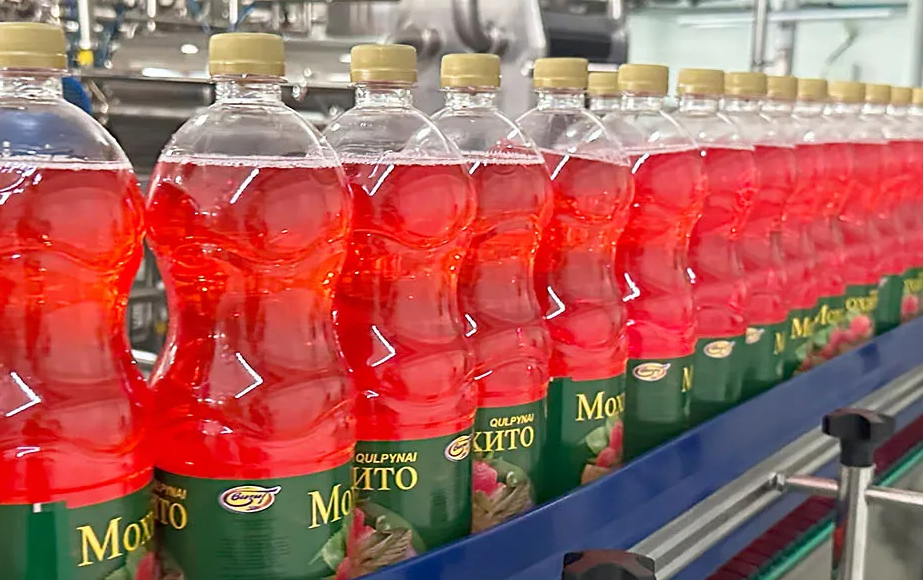
Bottled carbonated drinks moving through a Sunswell production line. Photo: Sunswell official website.
A plant that intends to run both products needs a written changeover concept. Ask which product-contact circuits are shared, how cleaning is verified, whether aroma carryover is acceptable and how the system will handle different closures. Allocate the lost production time in the sales model. Flexibility has value only when the actual changeover is operationally manageable.
Treat single-serve PET, family PET, cans and glass as distinct distribution and production choices. They differ in transport weight, handling, breakage exposure, filling compatibility and end-of-line equipment. Do not label one format “preferred in Chile” or “standard in Argentina” without evidence for the relevant category and channel.
Buy samples from the target outlets and request drawings from prospective packaging suppliers. Define bottle volume, neck finish, dimensions, cap geometry, label area and bundle configuration. For carbonated drinks, validate the container and closure at the intended carbonation level, storage conditions and transport exposure. A bottle that survives a short factory trial may still fail under sustained distribution conditions.
Include the availability of preforms, closures, labels and film in the country comparison. Two local sources for a critical item may reduce launch risk, but switching between them requires equivalent specifications and trials. Record approved revisions and prohibit unreviewed substitutions. A slight closure change can affect feeding, application torque and leak performance.
Calculate capacity separately for each commercial format. An illustrative order book of 480,000 bottles per month, with 20 production days, eight scheduled hours per day and an assumed 65% combined production factor, requires approximately 4,615 nominal BPH. The calculation is 480,000 divided by 20, divided by eight, divided by 0.65. It is a sizing example, not a forecast for either country.
| Условия планирования | Consequence for selection |
|---|---|
| Stable demand in one main format | Compare sustained output and maintenance needs on that format |
| Many short runs | Give greater weight to cleaning and format-change duration |
| Крупные сезонные заказы | Compare overtime, inventory and an additional shift before increasing speed |
| Expansion dependent on unsigned contracts | Show the expansion as a separate investment stage |
A 500 ml rating cannot be carried unchanged to a large bottle. Ask suppliers for a format-by-format rate table and the corresponding limits of blowing, filling, labeling and packing. Specify a sustained test using representative product and packaging. Measure accepted finished packs rather than counting only bottles at the filler outlet.
Use the same project scope in both country models. Include land or rent, building works, source access, treatment, machinery, utilities, freight, local handling, installation and working capital. For CSD, add the CO2 supply arrangement, chilling duty and appropriate gas storage or supply infrastructure. Validate each item with a local quotation or documented assumption.
Compare operating costs per saleable liter and per saleable pack. The first measure helps compare product volume; the second captures format and handling differences. A small bottle often carries more packaging and distribution activity per liter than a family pack. Report both measures when evaluating a mixed-format plant.
Run downside cases one driver at a time: lower sell-through, higher preform cost, longer customer payment terms or additional freight. State the date, currency and tax basis of every financial input. No general equipment-price band can replace a quotation based on agreed bottles, products and contractual boundaries.
Prepare a concise requirements sheet with the installation country, target outlets, product recipes or categories, bottle and closure drawings, format-specific annual volumes and production calendar. Add utility conditions, building dimensions, inspection access and the language needed for operator materials. Ask suppliers to identify exclusions and all information still required for a firm offer.
Request the same acceptance evidence from every bidder: output by format, filling consistency, closure integrity, reject handling, cleaning procedure and a complete pack trial. For the carbonated option, discuss the CSD filling equipment against the agreed product and package conditions, rather than comparing valve counts alone. A technically suitable shortlist should emerge from those requirements and the local cost model together.
The official country list identifies Chile as an Associate State. Verify the agreement and origin treatment relevant to the intended transaction before making an export assumption.
Only after packaging qualification for both duties. Carbonation changes the pressure and closure requirements, so similar appearance does not establish suitability.
Labor is one input. Compare total delivered cost, serviceable sales, packaging supply, utilities and financing needs before choosing the site.
Yes, if the commercial and technical basis is kept consistent and local differences are listed explicitly. Installation conditions and country-specific documentation still need separate confirmation.



 +86 13921964455
 [электронная почта защищена]

Промышленный парк A2 Дунцзю, 30 East Jintang Road, Танши, Чжанцзяган, Цзянсу 215600, Китай


